Governments the world over are encouraging more people to use bicycles, and various forms of crowdsourcing are used to support their efforts. This article looks at co-creation to map popular cycle routes in a city; automated sensors and data collection to monitor traffic levels in smart cities and control the flow; and the use of civic crowdfunding to steer local authority decision-making and influence local residents and other stakeholders.
At a macro level the benefits appear to be evident. Reduced traffic levels reduce congestion and air pollution. The built environment needs less space used for parking. A fitter and healthier population puts less pressure on the health services.
At a personal level, cyclists feel empowered by measures they are taking to protect the environment and improve their physical fitness. And right now, cycling is being promoted to reduce the number of people using public transport to help maintain social distancing.
The GB Bicycle Association reported that in the first full month of lockdown, April 2020, sales of bikes priced at between £400 and £1000 more than doubled compared to April 2019 (rising by 112% in number, 99% in value). A UK Government scheme offering online vouchers for use as payment towards repairing old bicycles to a state of roadworthiness crashed under the weight of overwhelming demand.
Co-creating route maps
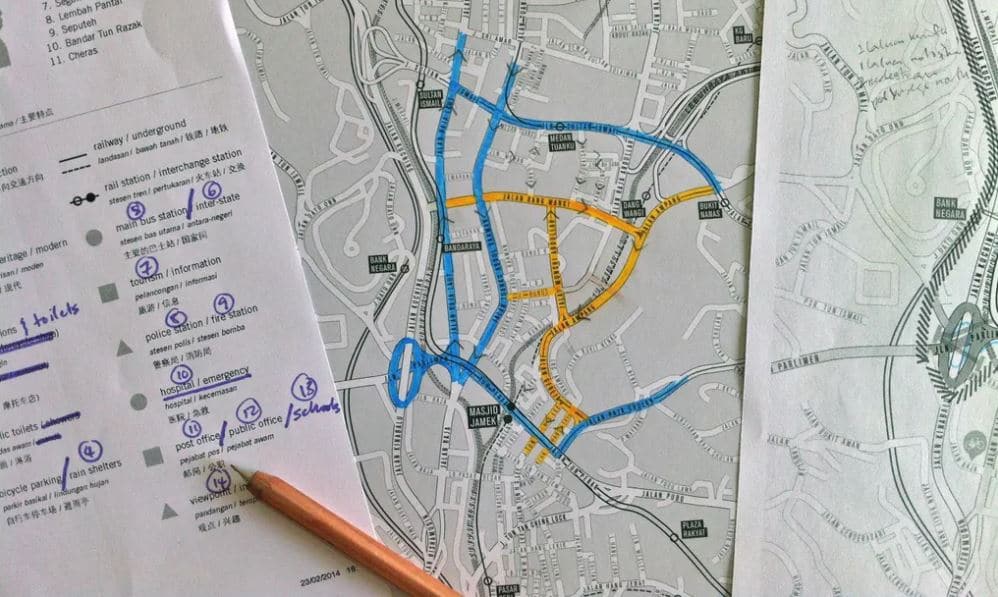
Road safety remains the paramount issue, more so among female cyclists. A crowdsourcing project in the Indian city of Bengaluru, run by the Directorate of Urban Land Transport (DULT), has asked the city’s cyclists for details of their favoured routes through the city, and where they would like dedicated cycle lanes installed. DULT’s aim is to team up with the city civic body and create an initial 34 km network of routes in the outer parts of the city before working into the centre, eventually making the whole city more cycling friendly.
It follows a similar exercise carried out in Kuala Lumpur, Malaysia. Car ownership stands at 93% of households, the third highest level of any city in the world, and much of the city centre is a cycle no-go zone. The bold efforts of Jeffrey Lim, a keen cyclist and vintage cycle restorer, saw city authorities earmark a $765,000 budget to create the city’s first cycle lanes.

Smart city traffic management
Many major cities have bike-sharing schemes. In 2015, Barcelona launched its “Bicycle Strategy for Barcelona” government measure, which encouraged increased bicycle use as a habitual mode of urban transport. Its ‘Bicing’ bike share scheme was suspended when emergency measures were first introduced to tackle Covid-19 in April 2020, though from the start of June the network was re-opened with 97 new hire stations planned, and more than 1,000 additional new cycles available.
Beyond bike-sharing, Copenhagen has installed intelligent traffic signals that prioritise bikes and buses over cars. This system can potentially reduce bus travel time by 5–20% and cycle travel time by 10%. Copenhagen has also built a citywide network of protected bike lanes, as laid out in its strategic plans published in 2011. Local authorities across the country collect as much data as possible, both quantitative and qualitative, to inform their decisions on anything related to cycling.

Transport for London similarly uses video sensors with artificial intelligence capability at 20 locations across London to detect the volume of different modes of transport, especially cyclists and pedestrians. This data will be used to assess demand for new cycling routes in the city.
Civic crowdfunding for cycle routes
Crowdfunding has been a successful way for several cycling related startups to sell products and launch a business through selling equity. I’ve seen projects for cycle wear that lights up at night time, bicycles made of bamboo, even a cycle repair business based on a barge travelling up and down English canals. Though there does remain an element of hostility from a minority of motorists – and pedestrians, understandably, when confronted by a cyclist using the pavement.
Hostility, or at least deserved wariness, runs both ways. I‘m a regular cyclist, and I’ve had two shoulder operations due to accidents caused by a car drivers and a passenger. I also know what it’s like to be abused by drivers for things like not being able to go as fast as they’d like me to, or for being annoyed when they turn across me without indicating. So I do have a personal interest in dedicated cycle routes.
Critics of such routes complain they restrict road widths for vehicles, actually increasing congestion and journey times, and pushing higher traffic levels on to roads that were previously less busy.
Civic crowdfunding can not only raise some of the cost of cycle routes to influence local authority decision-makers (more usually design and feasibility studies than actual construction costs), but can also operate as a marketing initiative to influence residents and other stakeholders in a community.
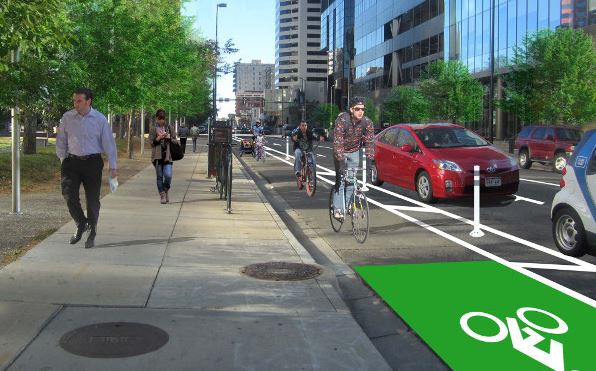
This strategy worked well in Denver (fantastic place, 360 days a year with sunshine!), when Colorado’s biggest city built its Arapahoe Street protected bike lane. Community organisations engaged residents and business owners early in the design process, and this made a huge difference. The Downtown Denver Partnership, a local business group, initiated the project based on what it had heard from business leaders. To build on this public support, it launched a crowdfunding campaign to cover $35,000 of the design costs.

“Letting communities vote with their dollars isn’t just about budgets. It is much more about letting local residents and businesses know early on about the project and allowing them to participate in a meaningful way,” said Kate Gasparro, Graduate Research Fellow of Sustainable Design and Construction, Stanford University.
Three ways crowdsourcing is boosting cycling
Whether it’s research among cyclists drawing their favoured routes on paper maps, sophisticated traffic management technology in smart cities, or civic crowdfunding to let all elements of a community input ideas as well as raise money, the effects are boosting the takeup of cycling the world over.
I originally wrote this article for Crowdsourcing Week. Please contact me if there’s anything you’d like to ask or discuss about running a crowdfunding project. Email me at [email protected]


 Rubies in the Rubble set a target raise of £300,000, in which Mustard Seed’s investment easily covered the 30% requirement. By 3 June 2019 the project on Seedrs has easily surpassed the initial target and wss overfunding at over £535,000. The funds are to support the launch later in the year of a mainstream ketchup product and a vegan plant-based mayonnaise. The business aim is to capture 3% of the UK ketchup and mayo market by 2023, whilst continuing the fight against food wastage. A trade sale is the most likely exit strategy.
 After they launched in 2016, I met up with the startup team at the London Boat Show in January 2017. Almost all privately-owned pleasure/leisure boats remain unused for the majority of their lives, moored up and incurring charges in commercial marinas or yacht clubs, while the cost of boat ownership remains prohibitively expensive for the majority of people.

 Examples that relied on traditional media to leverage the message include t
 One incident, when she was still a cash-strapped startup just beginning to get the first shops to stock her products, involved hiring a dozen actors. They pretended to be plastic surgeons and demonstrated outside the Selfridge’s department store to try and prevent them stocking her cleavage-enhancing underwear.
 A current example is the Royal Mail which has installed four musical post boxes in the run-up to Christmas. When cards and letters are posted they trigger a sensor that plays a loop of snippets from Christmas tunes and reindeer sleigh bells.
 For example, VCs were queueing up to invest in
 Even if it’s not a main aim of the crowdfunding, it could find you an angel investor. This happened to some people I know who started a business making tissues from bamboo. To begin with, all they wanted was an initial £10,000 of orders through rewards crowdfunding to provide validation they weren’t wasting their time. A backer was impressed with what he saw and stepped forward to invest, which allowed the founders to greatly speed up product development and company growth. So do eveything as professionally as possible.
 breaking a crowdfunding campaign down in to component parts each potential risk can be addressed and minimised. I’ve created a Seven Stage Assessment to check if a business is ready to start crowdfunding, and identify areas that need to be addressed before going public.
 To close, what you see online when people and organisations run crowfdfunding campaigns is like the tip of an iceberg visible above the waterline. Invisible under the water is a vast amount of planning and preparation, and a fair amount of stress. It’s not impossible to run a crowdfunding campaign alone if you’re tough and resiliant enough, though most people need some help and support, be it technical or emotional or anything else. This comes either from a team of willing supporters who between them provide all the necessary skills required to achieve your success, or you need a budget. Most times it’s a bit of both. If you want to talk about your ideas that could transform your life please get in touch,