
Mass digital connectivity and the personal tools that have enabled the sharing economy to flourish have created a climate of transformational change in which many business sectors have been disrupted almost beyond recognition.
Many retail brand names have virtually disappeared from urban high streets as book, record and camera shops are largely bygone relics of the age when shopping experiences were concentrated there. Renting videos and DVDs in person, going to a bank, saving up to buy a car and searching for affordable hotels to stay in are actions that are either obsolete or in decline now that we can go online to use LoveFilm, Netflix, Spotify, banking services, Uber, Airbnb and many other time saving, on-demand and improved value services that a myriad of entrepreneurs want to offer us.
Or if we are among the people with a spare room, attic space or a car parking space to rent out, or even largely unused clothes and furniture, then we can earn some money by offering them for hire to people we are matched up with online. A surplus of personal residential space (a big house!) and a wardrobe of designer label clothing are still regarded by many people as status symbols, helping them feel comfortably higher up Maslow’s hierarchy of needs. Now they are loaned out to strangers.
In crowdfunding – the ‘alternative finance’ area in which I operate as an independent crowdfunding adviser, mentor and personal trainer – those with sufficient disposable income are prepared to support startup businesses launched by people who in some cases they have never even met, either through ordering products that can be at still a prototype stage or for equity in a company they like the look of but which provides no guarantee of successfully providing a return on investment.
So it’s not just a case of technology and connectivity making it easier to behave the same way that we did before. There has been a well-documented and fundamental shift of attitudes towards more emphasis and value on what we can do with money that makes us feel good about ourselves, rather than primarily what we can buy and keep to ourselves to support and project our self-esteem.
Two news items I recently came across in the crowdsourcing/sharing economy heartland of cars and accommodation brought this home to me.
 Uber commissioned some research among a sample of 2,000 Londoners. 34% of Londoners used an app to book a car in the last 12 months, rising to over 55% of 16-34 year olds. 22% of current car owners would consider giving up their vehicle if they could even more easily get a car on demand by app. 13% of adult Londoners under 30 don’t have a driving licence and have no intention of getting one. London may well not be typical of the whole UK, though the trends appear deeply entrenched among a population that is bigger than that of countries such as Austria, Denmark or Hungary.
While working for a client in the construction sector I read about planning permission approval for a 19-storey tower block in Stratford, London, the main venue for the 2012 Olympic Games. This would be a residential tower block with a difference. Personal space in the 250 units will be scaled down to a minimum that can still satisfy privacy and security issues, to the point of each unit having a “kitchenette” without some of the supposed essential white goods we rely on. The trade-off for limited personal space is that residents will have access to a comprehensive range of communal facilities that not so long ago were the lifestyle trappings of only the better-off. These include a gym, cinema, roof terrace, sauna and hot tubs, library and a food market. It will open late 2018 or early 2019 and rooms will start from £230 a week including utility bills, council tax, wifi, cleaning and gym access
I have spoken with people from several large property developers recently. Planning and building design trends include wider corridors to make it easier to more regularly bring furniture in and out depending on whether a multi-purpose spare room is going to need a hired bed for friends to stay over, or a borrowed table and chairs to invite guests to dinner. In response to recent public consultations, residential projects at planning stages are also often reducing the amount of car parking space to provide more provision for safe and secure storage of bicycles.
These signs of largely Millennial-influenced lifestyle changes may not be for everyone, though they are certainly more than passing fads. This includes using more money, perhaps through supporting crowdfunding projects, to feel good by helping others achieve a personal ambition rather than pursuing a blinkered path more restricted to the acquisition of personal possessions.
If you are one of the growing number of people who seek funding to transform a personal business ambition in to a satisfying reality, then please get in touch for a free initial discussion (in person in London or via Skype) on whether some form of crowdfunding could do the job for you: [email protected], an independent crowdfunding adviser.


 If you are based in the UK and considering any form of crowdfunding to raise money for a business startup, to scaleup an existing business, or to use a crowdfunding platform as a sales channel for your products, then please get in touch if you’d like a free and confidential consultation with an independent crowdfunding adviser – which is me! Call 07788 784373 or send an email to
 Their eventual idea was to make tissue paper, and the first version was toilet rolls. This was a great choice, as tissue made from bamboo pulp rather than paper is stronger, softer, and naturally more hygienic. Their idea also had strong economic and ecological benefits: it would create work, benefit the local ecosystem to clear away some of the surplus bamboo being left to rot, and making tissue from bamboo produces a 65% lower carbon footprint than making it from trees or recycled paper.
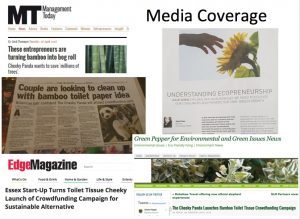 they amplified through their website and social media. They also courted relevant trade and professional media, and through a flexible content plan achieved coverage in Management Today and FMCG News (fmcg = fast moving consumer goods, a “must read” for anyone in the supermarket business) as well as local media in Essex, the Daily Mail and Huffington Post. I met Chris and Julie at an event at
  The fourth event in my sequence of five was a visit to The London Business Show 2016 at Olympia. Among hundreds of exhibitors and scores of seminar presenters I heard